The NAS Building
... a Temple of Science
"A national focus of science and research. . ." Thus George Ellery Hale, distinguished scientist and foreign secretary of the National Academy of Sciences, described his hopes for the Academy. Hale was the animating spirit behind the drive to build a home for the Academy. He propelled his vision toward reality, as earlier he had spurred the creation of the National Research Council, through which the Academy provided scientific advice to the government.
The National Academy of Sciences was chartered by Congress in 1863 as an honorific society. For the first half century of its history, the Academy conducted its activities in borrowed quarters. During World War I, the federal government markedly increased its reliance on the Academy for advice on scientific and technical matters. In 1916, with the founding of the Academy's operating arm, the National Research Council, the need for a permanent home became urgent.
Hale's remarkable energies equalled his stunning intellect. He spearheaded a fund-raising campaign for the building, engaged Bertram Grosvenor Goodhue, a leading American architect, agonized over myriad details during construction of the building, and even contributed to the motto destined to be inscribed in the dome of the Academy's Great Hall:
To science, pilot of industry, conqueror of disease, multiplier of the harvest, explorer of the universe,
revealer of nature's laws, eternal guide to truth.
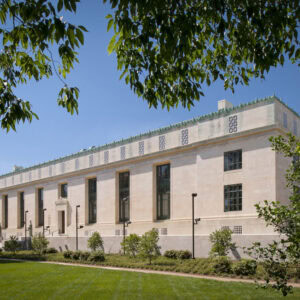
In 1924, Goodhue's neoclassic building on the mall in Washington, D.C., was dedicated before an assemblage of the leading scientific and political figures of the day. President Calvin Coolidge, delivering the principal address, declared that the "magnificent building now being dedicated to science predicts a new day in scientific research."
Acquiring a headquarters in the nation's capital enabled the Academy, through the National Research Council, to play an ever more significant role in the nation's scientific life. The institution has succeeded in enlisting the finest American scientific minds of the century in fulfilling its mandate to advise the government on science and technology policy. Today, the National Academy of Sciences, the National Academy of Engineering, the Institute of Medicine, and the National Research Council are unique among the world's science academies in the broad scope of services it renders to our nation's Executive Branch and to the Congress. In addition, the Academies' studies and reports are influential in the private sector and in the international sphere.
Read More:
... A Temple of Science
Recognition of Need
The Architect
The Setting and the Grounds
Description of the Building
The Façade
The Window Panels
The Doors
The Main Foyer and the Great Hall
The Library and the Members' Room
The Lecture Room and the Board Room
The Wings
The Auditorium
The Albert Einstein Memorial
Restoration of the NAS Building
Photo by Carol M. Highsmith