About the Award
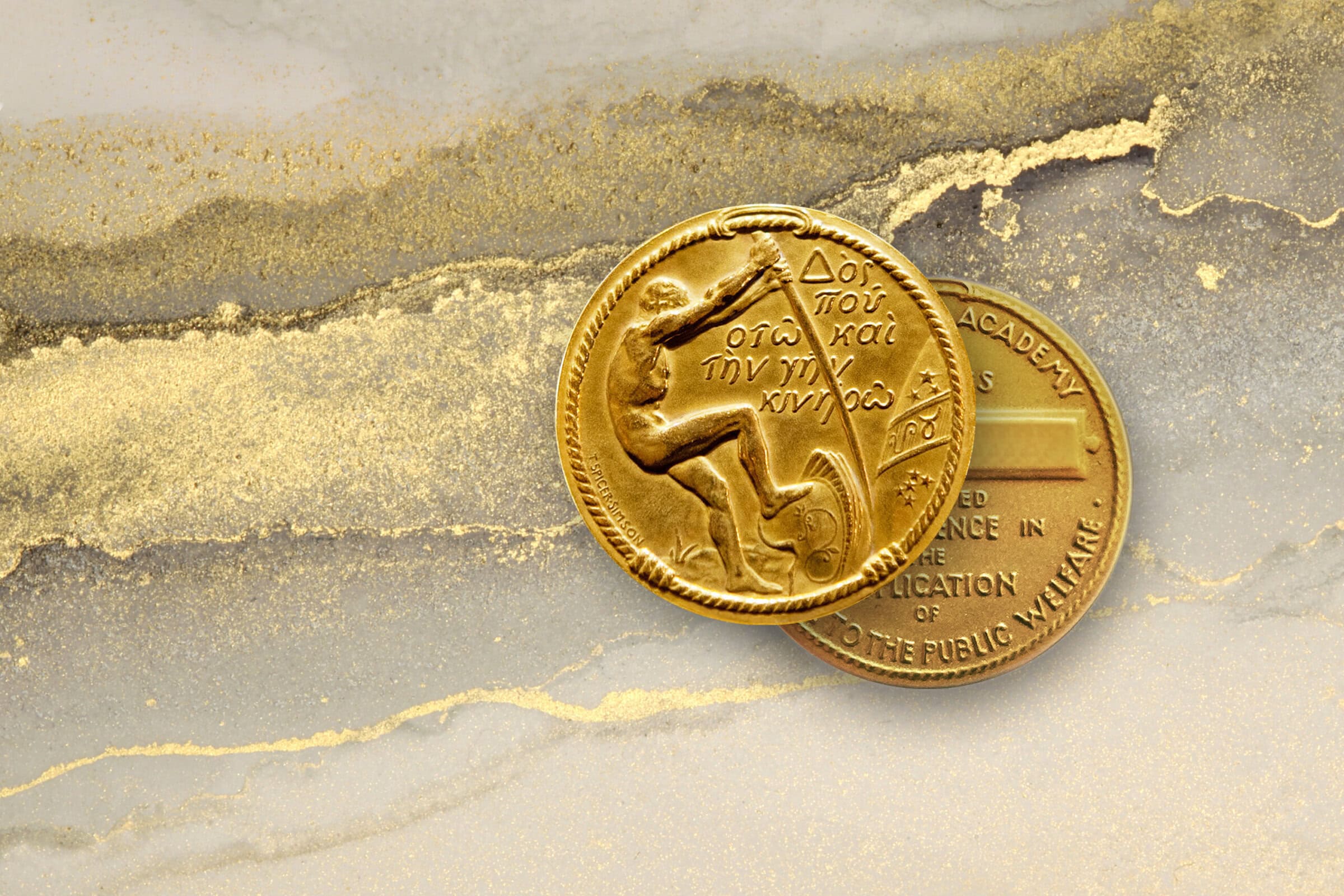
The NAS Public Welfare Medal is the Academy’s most prestigious award and is presented annually to honor extraordinary use of science for the public good.
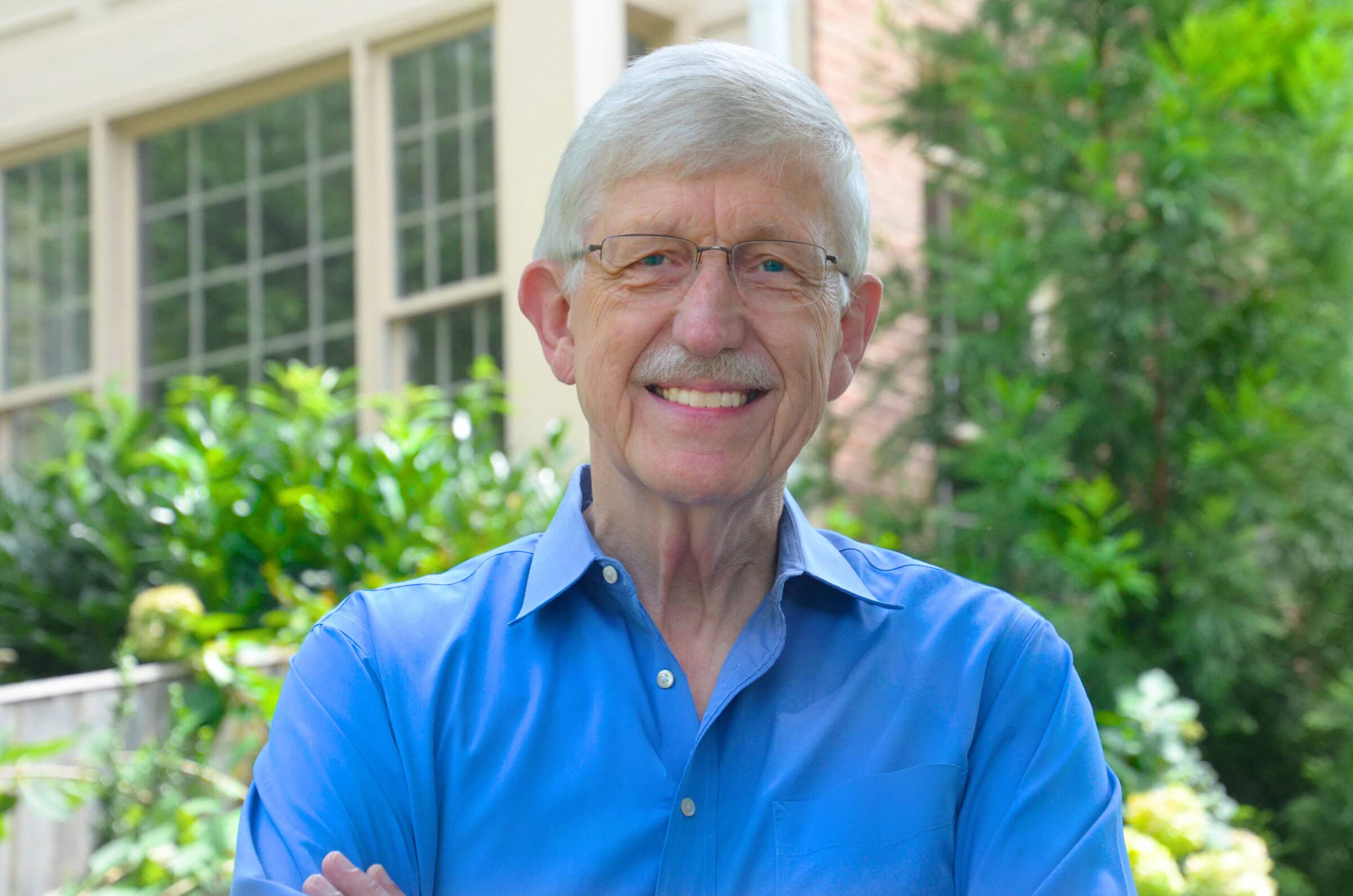
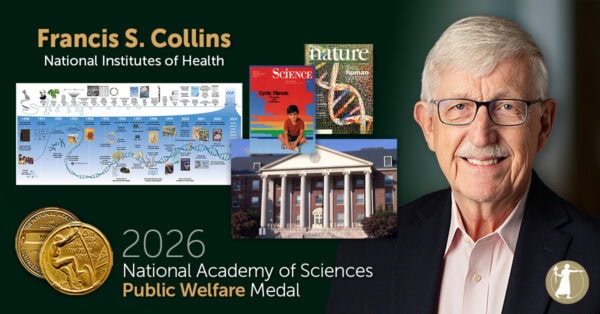
The 2026 Public Welfare Medal will be presented to Francis S. Collins, former director, National Institutes of Health (NIH), for his pioneering research in human genetics and critical contributions to public welfare as the leader of the Human Genome Project. Collins’ scientific and public service career has advanced understanding of human disease, strengthened ethical frameworks in genetics, fostered public trust in science, and guided national and global responses to health crises. The medal is the Academy’s most prestigious award, established in 1914 and presented annually to honor extraordinary use of science for the public good.
When Collins became director of the National Center for Human Genome Research at the NIH in 1993, he assumed responsibility for coordinating the Human Genome Project, an ambitious, multinational enterprise that grew to involve hundreds of scientists and dozens of sequencing centers. Collins helped define how large-scale science could be organized, creating a collaborative framework that balanced scientific ambition, technical innovation, and ethical responsibility. He oversaw sequencing strategies for model organisms, coordinated international research efforts, and implemented the Bermuda Principles, which required daily public sharing of genome sequence data — an unprecedented commitment to transparency. Collins also played a key role in developing the Genetic Information Nondiscrimination Act (GINA), legislation that protects individuals from misuse of their genetic information. Despite intense scientific, political, and financial challenges, the Human Genome Project culminated in the first complete human genome sequence, a landmark achievement that has transformed biomedical research, enabled precision medicine, and laid the groundwork for therapies targeting a wide range of genetic diseases.
Collins’ impact on public welfare extends beyond the Human Genome Project. As director of the NIH from 2009 to 2021, he led the agency through three presidential administrations, strengthening federal biomedical research and guiding responses to critical public health challenges, including the Ebola epidemic and the COVID-19 pandemic. He championed funding for Alzheimer’s research, initiated the BRAIN Initiative to advance neuroscience, launched the Cancer Moonshot program to accelerate cancer research and treatment, and pioneered a major initiative in precision health that included the launch of All of Us, the largest longitudinal cohort study ever mounted by NIH. From 2022 to 2023, he served as special advisor to the president, co-chairing the President’s Council of Advisors on Science and Technology and spearheading a national initiative to eliminate hepatitis C.
“Francis Collins has helped shape the way we conduct large-scale biomedical science,” said National Academy of Sciences Home Secretary Nancy Andrews. “His visionary leadership of the Human Genome Project, combined with decades of public service, exemplifies the profound ways science can improve human health and welfare.”
“Through his scientific insight, ethical leadership, and public advocacy, Dr. Collins has strengthened public trust in science and demonstrated how discovery can serve humanity,” said National Academy of Sciences President Marcia McNutt. “His career is a model of scientific excellence applied for the common good.”
Prior to his leadership at the NIH, Collins conducted pioneering research in human genetics. His laboratory at the University of Michigan, and subsequently at NIH, used positional cloning to identify genes responsible for a range of inherited diseases, including cystic fibrosis, neurofibromatosis, Huntington’s disease, multiple endocrine neoplasia, Alagille syndrome, and Hutchinson-Gilford progeria syndrome. His work has also advanced understanding of complex diseases such as type 2 diabetes, establishing foundational principles that continue to guide biomedical research worldwide.
Collins’ extraordinary contributions have been recognized with numerous honors, including election to the National Academy of Sciences and the National Academy of Medicine, the Presidential Medal of Freedom, the National Medal of Science, the Gairdner Foundation International Award, the Templeton Prize, and election as a foreign member of the Royal Society (UK).
Collins earned his B.S. in chemistry from the University of Virginia, an M.Phil. and Ph.D. in physical chemistry from Yale University, and an M.D. with honors from the University of North Carolina, where he also completed residency and fellowship training. His early postdoctoral work at Yale on the molecular basis of fetal hemoglobin persistence laid the groundwork for his career in human genetics.
The Public Welfare Medal will be presented to Collins on April 26 during the Academy’s 163rd annual meeting.
Award History
Over the past 100 years the NAS Public Welfare Medal has continued to recognize those individuals who have worked tirelessly to promote science for the benefit of humanity. Previous recipients of the medal include Alan Alda, Neil deGrasse Tyson, Anthony S. Fauci, Bill and Melinda Gates, Ismail Serageldin, Neal Lane, Norman Borlaug, William T. Golden, Maxine F. Singer, C. Everett Koop, and Carl Sagan.
The first NAS Public Welfare Medal was presented in 1914 to George W. Goethals and William C. Gorgas for their distinguished services in connection with the building of the Panama Canal. Goethals was the chief engineer of the canal project, which was completed two years ahead of schedule. Gorgas acted as chief sanitary officer on the canal project, and implemented far-reaching sanitary programs that were instrumental in permitting the construction of the Panama Canal, as they significantly prevented illness due to yellow fever and malaria.
Previous recipients of the NAS Public Welfare Medal continue to achieve outstanding advancements in their fields. Seven recipients have been honored with a National Medal of Science, and two recipients have received a Nobel Prize in Physics (Rabi 1944), and Peace Prize (Borlaug 1970).
Most Recent Recipient