About the Award
The NAS Award in Molecular Biology is supported by Pfizer Inc. and recognizes a recent notable discovery by a young scientist (no older than 50) who is a citizen of the United States. The award is presented with a medal and a $25,000 prize.
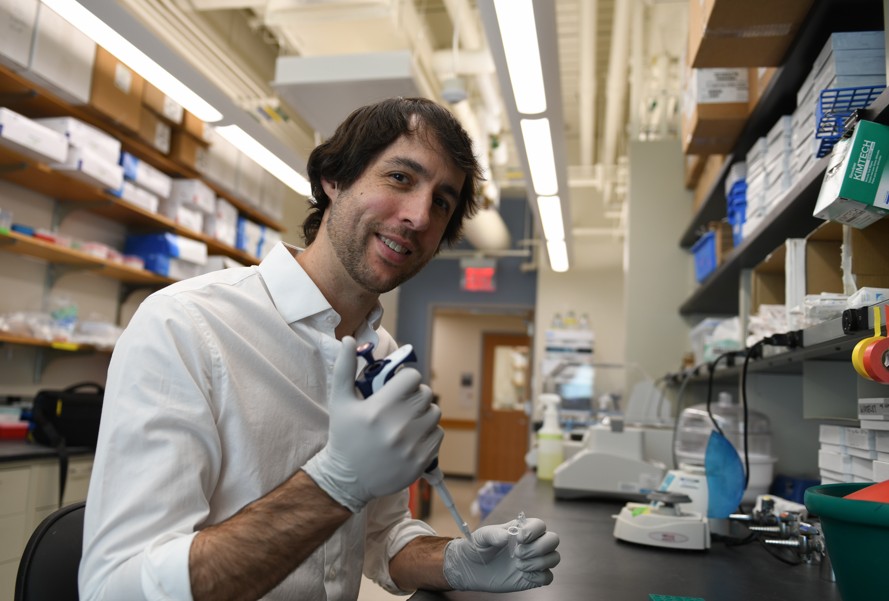
Philip J. Kranzusch, Dana-Farber Cancer Institute and Harvard Medical School, will receive the 2026 NAS Award in Molecular Biology.
Kranzusch’s seminal work has transformed our understanding of human innate immunity and revealed its evolutionary roots in bacterial antiviral defense, reshaping both microbiology and immunology.
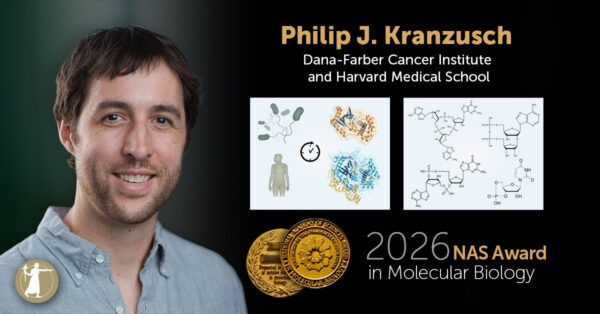
His research investigates how cells detect and respond to viral pathogens and how these signaling pathways can be harnessed to develop new therapies to treat infections, cancer, and autoimmune diseases. Through a series of discoveries, Kranzusch demonstrated that key components of human innate immunity, including those targeted by vaccines and in cancer immunotherapy, evolved from ancient pathways used by bacteria to defend against viral infection. He also uncovered nucleotide-based immune signaling mechanisms that control how human cells sense and defend against cancer and pathogen infection.
Together, these insights overturned long-standing assumptions about immune system evolution and opened new fields of study. Kranzusch’s work has far-reaching implications for human health, shedding light on immune mechanisms central to infection, cancer, vaccination, and autoimmune disease, and laying the groundwork for innovative therapeutic strategies.
Watch him receive the award online during the 163rd NAS Annual Meeting on April 26th.
Award History
The NAS Award in Molecular Biology was first awarded in 1962 to Marshall Nirenberg for his studies of the molecular mechanisms for the biosynthesis of protein. In 1959 Nirenberg began to study the steps that relate DNA, RNA, and protein. These investigations led to the demonstration with H. Matthaei that messenger RNA is required for protein synthesis and that synthetic messenger RNA preparations can be used to decipher various aspects of the genetic code (from Nirenberg’s Nobel biography). Nirenberg went on to win the Nobel Prize in Physiology for Medicine with Robert W. Holley and H. Gobind Khorana in 1968 for “for their interpretation of the genetic code and its function in protein synthesis.”
Previous recipients of the NAS Award in Molecular Biology continue to achieve outstanding advancements in their fields. Ten recipients have been honored with a National Medal of Science, 20 recipients have received a Lasker Award, and 15 recipients have received a Nobel Prize in Medicine (Nirenberg 1968; Holley 1968; Temin 1975; Baltimore 1975; Nathans 1978; Blobel 1999; Sharp 1993; Horvitz 2002; Blackburn 2009; Szostak 2009; Südhof 2013; Fire 2006; Mello 2006), and in Chemistry (Gilbert 1980; Cech 1989).
Most Recent Recipient