Every June 30th, Asteroid Day marks the anniversary of the 1908 Tunguska impact and turns global attention to the science of near-Earth objects and planetary defense. But asteroids and the meteorites that fall from them are more than just a planetary hazard — they’re some of the oldest, most information-rich material in the Solar System. To mark this year’s Asteroid Day, we spoke with Meenakshi Wadhwa, a cosmochemist who studies meteorites and astromaterials returned by missions like Apollo, Genesis, Hayabusa2, and OSIRIS-REx to reconstruct the earliest chapters of our Solar System’s history. She explained why a fist-sized rock can hold a more pristine record of our origins than anything found on Earth, what scientists have pieced together about how dust and gas became planets, and why the popular fixation on “killer asteroids” misses the more compelling story these objects tell.
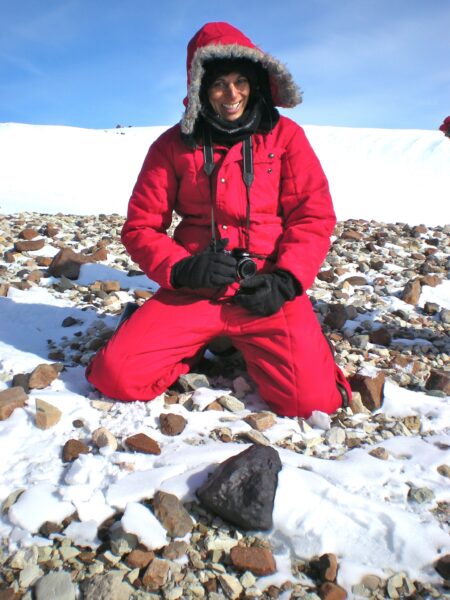
Photo courtesy of M. Wadhwa
What first drew you to studying meteorites and asteroids, and what continues to surprise you about them today?
What first attracted me to studying these “rocks from space” was the realization that a single rock you can hold in your hand can be older than Earth itself and carries a record of events in our Solar System before any planet existed. I found it irresistible that you could read a record of our Solar System’s birth in minerals and isotopes frozen nearly 4.5 billion years ago. What still surprises me is how rich the information packed into such small samples can be. For example, tucked inside some meteorites are presolar grains, actual “stardust” that formed in other stars before our Sun ignited. Studies of these tiny particles (ranging in size from a few nanometers to a few micrometers) continue to reveal incredibly detailed information about how processes work in the interiors of stars to form the elements that make up everything.
Your work uses meteorites and returned samples to reconstruct the earliest history of the Solar System. What makes these “space rocks” such powerful time capsules?
On Earth, geologic processes have effectively erased the ancient record of our planet’s beginnings. Processes like plate tectonics and weathering have recycled or destroyed nearly all the rocks from our first hundred million years. Asteroidal materials (represented by meteorites and returned samples) have escaped that fate. The most primitive types of meteorites, the chondrites, have remained essentially untouched since the Solar System’s earliest moments, preserving the very first solids that condensed from the disk of gas and dust around the young Sun. My own work with such samples utilizes the fact that they come with built-in clocks that can give us a high-resolution picture of the timing of events in the early Solar System. Short-lived radioactive isotopes present at the start of our Solar System, like aluminum-26, decayed away long ago, but they left fingerprints that let us date events to within a million years or better, 4.5 billion years after the fact. Few records anywhere in nature offer that combination of antiquity and precision.
What do scientists now think were some of the key steps that turned dust and gas into rocky planets like Earth?
It begins with a disk of gas and microscopic dust orbiting the newborn Sun. The first solids to form in that protoplanetary disk, the so-called calcium-aluminum-rich inclusions which we treat as “time zero” for the start of our Solar System, condensed directly from hot gas, soon followed by the millimeter-sized chondrules. These early-formed solids had to clump together, and getting past the stage where pebble-sized objects either bounced apart or spiraled into the Sun was long a puzzle. Current thinking is that disk turbulence concentrated material until gravity could take over, rapidly assembling kilometer-scale planetesimals. Those bodies then grew by sweeping up pebbles and colliding with one another into larger embryos. The final terrestrial planets were built through giant impacts between these embryos over tens of millions of years, with the Moon-forming impact being the dramatic finale for Earth. Heat from decaying aluminum-26 and from the impacts themselves melted many of these rocky bodies, allowing iron to sink and form cores while separating the lighter, silica-rich material into mantle and crustal layers.
With samples from missions like Apollo, Genesis, and Hayabusa2, we now have a variety of materials from multiple worlds. What has comparing these different samples revealed about how common, or unusual, Earth’s formation may have been?
The samples returned by each mission have given us distinct but complementary perspectives on the formation history of our Solar System and planet. Apollo’s lunar samples helped elucidate the giant-impact origin of the Moon and clarified the timeline for the formation of the Moon and the Earth. Genesis captured solar wind, allowing us to measure the composition of the original solar nebula; this composition serves as the baseline for comparison to Earth, and provides insights into the processes that formed our planet. The recent asteroid sample return missions Hayabusa2 and OSIRIS-REx, which returned samples of asteroids Ryugu and Bennu, respectively, have also provided some unique insights. Analyses show these two asteroids are remarkably similar to one another and to the most primitive CI carbonaceous chondrites in our collections, rich in water-bearing minerals, carbonates, and sulfides that record intense aqueous alteration. They appear to have formed in a distant region of the early Solar System, and they preserve organic matter. When we compare samples from Ryugu and Bennu to Earth samples, the isotopic fingerprints for elements like oxygen, titanium, chromium reveal that the inner and outer Solar System were largely separate reservoirs of material. Earth was built mostly from rocky materials from the inner Solar System, but bodies like Bennu and Ryugu that formed in the outer Solar System represent the kind of volatile-rich, water- and carbon-bearing material that may have delivered the ingredients for oceans and life. So the underlying physics of planet-building looks general and repeatable; what made Earth Earth was the particular mix it received, including a likely late delivery of volatiles from the outer Solar System.

Photo courtesy of Erik Jepsen, UC San Diego
What do you think people most misunderstand about asteroids, and what would you most want the public to appreciate about this field of science?
The “killer asteroid” headlines and movies always seem to capture public interest. Planetary defense is real and important, and missions like DART have shown we can actually do something about it. But that framing misses what is perhaps most interesting about asteroids: they are the leftover building blocks that formed the planets in our Solar System, literally the construction debris from our own origin story. Another common misconception is that they’re all alike. They’re astonishingly diverse: some are metallic fragments of shattered cores, while others are carbon-rich bodies carrying water and organic molecules. What I’d most want people to appreciate is that studying such materials is the most satisfying kind of detective science. We can take a grain smaller than a sand particle, measure its isotopes in a laboratory, and from that reconstruct events that happened before the Earth existed. We are living in a golden age of bringing pieces of other worlds home — and every sample rewrites part of the story of where we came from.
Latest Posts
Featured
October 5, 2026
NAS Members Receive Nobel Prizes

Special Feature
September 17, 2026
Beyond Calories: Jeffrey Gordon on How the Gut Microbiome Shapes Healthy Growth