
For Malnutrition Awareness Week, biologist and NAS member Jeffrey Gordon—widely considered the “father of microbiome research”—discusses how scientists are changing the way we understand and treat childhood undernutrition. Gordon explains what researchers have learned about the developing gut microbiome, how foods can be designed to support healthy microbial communities, and why the next generation of treatments may need to address not only calories and nutrients, but also the complex relationship between food, microbes, and the growing child.
What is one thing you wish everyone understood about malnutrition?
Undernutrition affects approximately 200 million children worldwide, driving nearly half of under-five mortality, stunting growth and disrupting development of the brain, immune system and multiple facets of metabolism. The burden is particularly acute in South Asia and sub-Saharan Africa. Food insecurity is a major contributing cause. However, an undernourished child can receive therapeutic foods with sufficient calories and micronutrients and yet still fail to fully achieve healthy growth and development; this failure underscores the need for a deeper, more comprehensive understanding of mechanisms that operate to produce a state of undernutrition, and new more effective interventions that are affordable, culturally acceptable and capable of being deployed at scale.
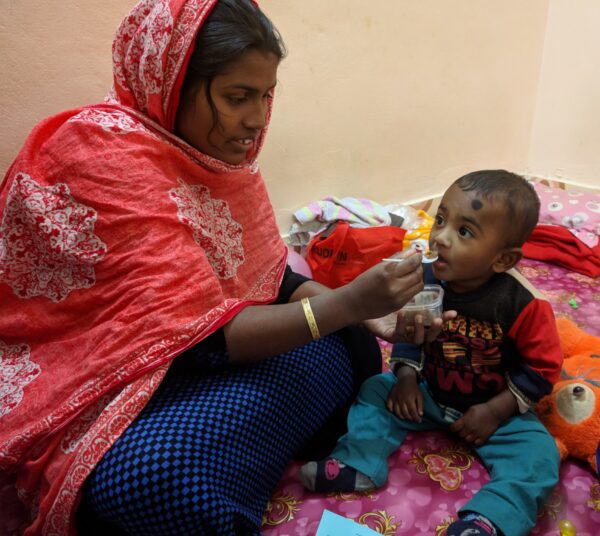 Undernutrition affects many interconnected aspects of a child’s physiology. Work from our group and others has shown that the normal development of our gut microbial community is closely linked to healthy childhood growth. In undernourished children, that development can be disrupted and simply providing more calories is not enough to repair it. This changes the way we think about treatment.
We are holobionts—collections of human and microbial cells and genes. The genes present in our gut microbial symbionts provide us with metabolic capabilities not encoded in our H. sapiens genome. We need to consider food from the perspective of our gut microbial symbionts; they ‘see’ food as collections of molecules rather than ‘labels’. The nutritional ‘value’ of food should factor in the state of a child’s microbiome.
The molecular components of the world’s food staples are being characterized at ever-increasing levels of detail—opening the door to deciphering the myriad metabolic reactions catalyzed by the master chemists that our gut microbes represent. We are learning the details of how microbial metabolites produced along the length of the intestine not only affect members of the gut community but also operate beyond the walls of the gut to affect many facets of physiology.
Because microbiomes pass from mother to child, it is also important to develop treatments to repair the intestinal microbial communities of undernourished mothers so that they can better support healthy prenatal as well as postnatal development of their offspring. Our long-term objective is to move progressively upstream—from treating established undernutrition to preventing disruption of normal microbiome and host development and ultimately breaking the intergenerational cycle of undernutrition.
What have scientists learned about the relationship between the gut microbiome, nutrition, and healthy growth in children?
One of the most important things we are learning is how beginning at birth and continuing through the first years of life, a healthy gut microbial community goes through a process of succession, or ‘maturation.’ This has led to the hypothesis that healthy growth of infants and children requires a well-coordinated, properly executed program of co-development of the gut microbiome and various organ systems. Our work and that of others has shown that particular gut bacteria are associated with healthy growth and that we can use specific foods to selectively promote those organisms and their expressed beneficial metabolic functions.
This has spawned a different way of thinking about food as therapy. Rather than only asking, “How much protein or how many calories does a child need?” we should also ask, “What nutrients will nourish the gut microbes whose functions are important for a child’s growth and development?” That idea has led us to the development of microbiota-directed foods (MDFs) for repairing the gut microbial communities of undernourished children. Initial randomized controlled studies of Bangladeshi children with moderate acute malnutrition have shown that MDFs produce improvements in ponderal and linear growth, as well as in circulating levels of protein biomarkers and mediators of healthy physiological development. These effects of MDFs extend beyond the treatment period and highlight the point that full ‘nutritional’ resuscitation needs to involve more than simply gain of weight and height but extend to repair of disrupted neurodevelopment, musculoskeletal development, disordered immune function and impaired metabolic regulation.
Establishing the generalizability of this approach necessitates randomized controlled clinical studies of MDFs versus standard nutritional interventions in undernourished children of different ages, living in different areas of the world where the burden of disease is great, and conducting long-term follow-up of the effects of this type of treatment. At the same time, cohorts of healthy children need to be studied to further define ‘normal’ microbiome development. These microbiome assessments also require simultaneous assessments of mediators and biomarkers of host physiology, such as those achievable with current methods that allow simultaneous measurements of thousands of blood proteins in small volumes of serially collected blood samples. These types of studies will also help address the question of ‘malleability,’that is to what extent do factors such as the age at which a child’s microbiome assembly is initially disrupted, as well as the duration and/or severity of the disruption determine responsiveness to attempted microbiome repair?
What has surprised you most about the relationship between the foods we eat and the microbes that live in our gut?
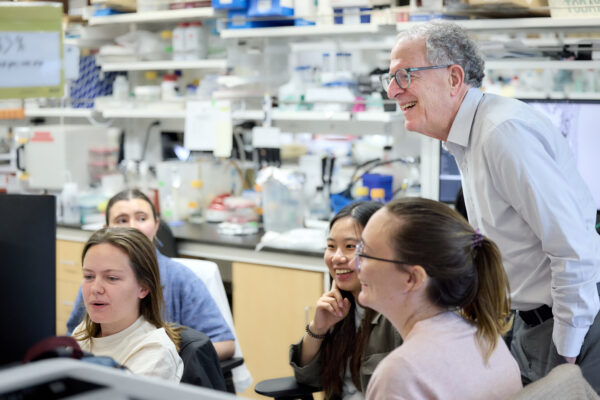
Jeffrey I. Gordon, the Dr. Robert J. Glaser Distinguished University Professor and Tahmeed Ahmed, executive director of the International Centre for Diarrhoeal Disease Research in Bangladesh. Matt Miller, Washington University School of Medicine
What continues to amaze us is how specificity is achieved in the face of such complexity—the mapping of the metabolic capabilities/preferences of growth-associated gut microbes onto the specific components of the food that we eat. While there is variation between individuals in the ‘names’ of the microbes that assemble in the developing gut community, there is also underlying conservation of critical metabolic functions in a healthy gut microbial community. There is also remarkable strain-level diversity; a given microbial species can be represented within and between individuals by different strains of that species with varying gene content. This diversity produces a breadth of capabilities that help make a healthy microbiome very adaptable and resilient. This diversity is key when we consider the diversity of foods consumed and the molecular complexity of their ‘nutrients’. For example, we tend to talk about “fiber” as though it were one nutrient. But fiber encompasses an enormous variety of complex carbohydrate structures as well as other types of molecules. Different gut bacteria have evolved very specific molecular machinery for recognizing and breaking down particular polysaccharide structures. Fibers from different sources can have different effects on the microbial community. This means food isn’t simply feeding us—the human host. Components of our food that we can’t digest ourselves are feeding an incredibly complex and dynamic microbial ecosystem.
This is one of the most fascinating ideas to emerge from this field; the biological effects of a food depend not only on what is in the food, but also on which gut microbes are present and available to metabolize it. The gut is spatially complex with variations in its microbial composition across its length and width. Yet microbes are able to establish food webs that allow them to share the products of their metabolism with one another and ultimately the host. A question is how are they able to dine together? One view is that food particles serve as sites of attachment/assembly of microbes with different metabolic capabilities. In this conceptualization, a primary microbial consumer of a given nutrient can produce metabolic products that a neighbor on that particle can then capture and, in turn, share its products with other components of this microcosm (think Dr. Seuss’s book Horton Hears a Who!). Concepts like this have implications for food science and the optimization of particle size and composition in foods to enhance their nutritional value.
Another concept to emerge from this microbial view of the nutritional value of food for growing children is alignment of recommendations for weaning foods and the sequence of their consumption with knowledge of their molecular composition and effects on key growth-promoting members of the developing gut microbial community. Such alignment should help ensure healthy microbiome maturation. The first several years in early postnatal life provide a ‘window’ of opportunity for promoting normal development of this microbial organ; if this goal is met, the effects on health status could/should be pervasive and the beneficial effects potentially long-lived. Developing point-of-care diagnostics to delineate the state of microbiome/host co-development will facilitate attaining this goal. Attaining this goal also requires the ability to test different culturally acceptable and affordable weaning foods on the developing microbiomes of different populations of children. Fortunately, we have the ability to determine the molecular composition of these foods (including different cultivars prepared using different methods) and to initially test their effects on different consumer microbiomes by colonizing gnotobiotic animals with microbial communities sampled from individuals representing different chronological ages, health states and geographies; this is the same approach that was used to develop MDFs. The preclinical results can guide decisions about subsequent clinical study design and interpretation.
What questions about nutrition and the gut microbiome are you still trying to answer?

Senior scientist Janaki Lelwala-Guruge, PhD, left, talks with Professor Michael Barratt, PhD. Matt Miller, Washington University School of Medicine
We are creating a dossier of evidence that MDFs can improve growth outcomes in undernourished children. The inspiring yet daunting task is to ‘connect the dots’—to identify interrelationships between the bioactive components of MDFs, their effects on growth-associated microbial targets, and how the metabolic products of these microbes function to shape host physiology.
For example, analyses of microbiome responses in clinical trials of MDFs have revealed that certain polysaccharides are key bioactive components of our therapeutic foods. We are using this information to advance a program aimed at capturing these polysaccharides from byproduct streams of food manufacture and assembling them into prebiotic mixtures that can be added to standard ready-to-use therapeutic foods or to locally available foods (akin to micronutrient sprinkles) to treat or prevent undernutrition. This represents an important path toward scale. Defined prebiotic mixtures could offer advantages in shelf stability, control of dosing, manufacturing and distribution, while recovery of bioactive compounds from food-manufacturing byproduct streams provides an opportunity to reduce cost and improve sustainability. The ultimate objective is to harness the biological activity of microbiome-directed foods in forms that can be integrated into existing nutritional interventions and food-delivery systems.
As noted above, a major goal of human microbiome research is to identify microbial metabolites that regulate various aspects of human physiology. Defining these molecules (‘postbiotics’) provides an opportunity to move from identifying beneficial organisms to understanding – and potentially directly reproducing – the products through which they affect their human hosts. These discoveries may ultimately yield defined ‘postbiotic’ interventions that complement food- and prebiotic-based approaches.
How rapidly and responsibly can we turn our growing understanding of the microbiome into interventions that are safe, more effective, affordable, and accessible to the children who need them most? The solutions will require an interdisciplinary approach that is mindful of the educational, economic, and anthropological as well as scientific dimensions of the challenge—a challenge that also necessitates new and deeper ways to integrate microbiome science, food science and human nutritional science.
Latest Posts

Special Feature
October 14, 2026
The Hidden Chemistry Beneath Our Feet: Susan Brantley on the Role of Rocks in Our Everyday Lives

Special Feature
August 20, 2026
World Mosquito Day Q&A with Nora Besansky: Understanding Malaria’s Most Vexing Vectors