Rocks are the source of many of the materials we rely on every day, but they also play a much broader role in shaping our planet. For Earth Science Week, which this year highlights critical minerals, we spoke with NAS member and geochemist Susan Brantley about her research on the processes that transform rocks over time—from weathering and interactions with water and living organisms, to their influence on soils, nutrients, and climate. She also discusses our reliance on materials mined from the Earth and the challenges of meeting society’s demand for critical minerals more sustainably.
Rocks can seem permanent, but they’re constantly changing. What’s happening to rocks beneath our feet that most of us never notice?
We think of rocks as permanent, but they are not! They break apart into particles and dissolve into salts and then wash away into the ocean over time. If the particles remain on land as a layer that retains water and organic matter, we call them soils. We refer to the breaking down of rock as weathering: it is the process whereby rocks formed at depth at higher temperature and pressure re-equilibrate to the Earth’s surface to form soil, sediments, and solutes. The way I just described weathering makes it seem like a chemical and physical process, but on Earth, weathering is also biological because soils are conditioned by plants and animals and they retain organic matter from all the biological activity. In fact, while geologists might consider soils as rocky material, ecologists just as accurately think of soils as ecosystems. Organisms affect weathering by secreting acids, by designing and releasing organic compounds that cause dissolution of minerals, and by changing the availability of oxygen and electrons so that minerals dissolve.
Your research explores what happens when water interacts with rocks. Why is that interaction so important to understanding our planet?
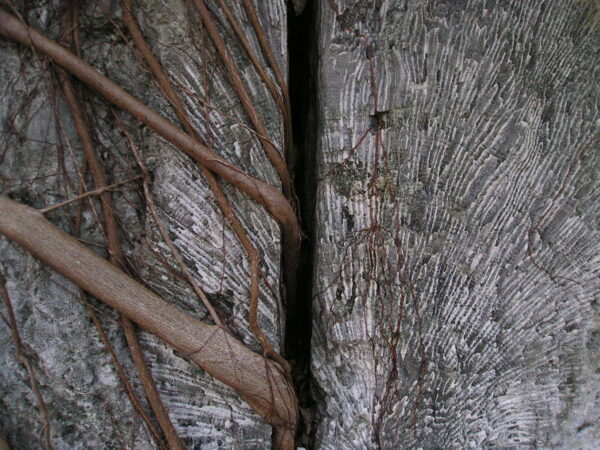
Limestone image with roots is a photograph of weathering limestone with plant roots entering in the cracks. Photo credit: Heather Buss.
Globally, water-rock interaction contributes to controlling the concentrations of gases like carbon dioxide and oxygen in the atmosphere. Since carbon dioxide is a greenhouse gas that affects global temperature, this means that water-rock interaction is a potential regulator of climate. And, since oxygen is a great acceptor of electrons, water-rock interaction contributes to the habitability of the planet for oxygen-breathing organisms like humans.
Water-rock interaction is also important because there are about 30 elements that are essential nutrients for life. Organisms generally get most of these elements through water because they cannot ingest rock particles. Perhaps the most important element that is solubilized from rock is phosphorus. Just like all plants and animals and microbes, we need phosphorus for a variety of reasons such as energy cycling in our cells. Phosphorus is the 11th most abundant element in Earth’s crust and is found in most rock, but it is generally present in low abundance. Most commonly, the element is found as calcium phosphate, a mineral known to geologists as apatite. In many locations, phosphorus is so low in concentration that its availability limits plant life: in old, highly weathered soils, apatite can be missing or tied up in insoluble form, and plants can only grow slowly.
But beyond nutrients that are solubilized from rock, water-rock interaction is also important for the prosaic reason that dissolution creates holes—porosity—which in turn can store essential fluids such as water, oil, and gas beneath our feet, and can provide shelter to organic matter and organisms. Most rock-dwelling organisms in Earth’s crust are single-celled, and they live and grow to depths extending kilometers beneath the soil surface. Such deep biota are ubiquitous and abundant, but we still know very little about them and how they impact rocks at depth.
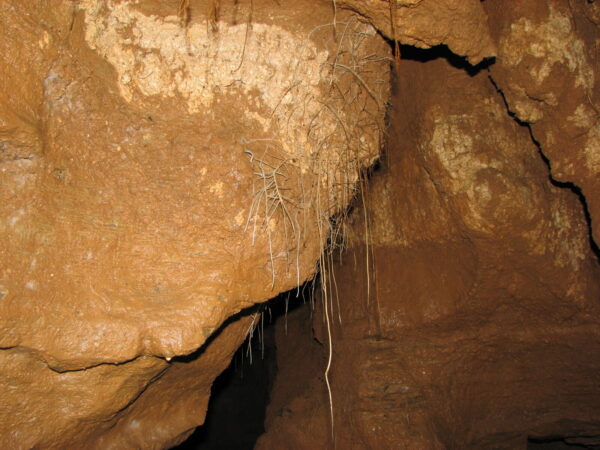
Plant roots reaching down 80 feet through limestone into a cavern in Lincoln Cave, Pennsylvania. Photo credit: Susan Brantley
What is something we encounter in everyday life that has a surprising connection to rocks, minerals, or geochemistry?
Apatite, the mineral that hosts phosphorus and weathers in soils to nourish ecosystems, is the same mineral our bodies precipitate to form bones and teeth. Luckily for those of us who like candy, this apatite is somewhat resistant to dissolution. But the resistance extends only down to acid strengths equivalent to about pH 5.5, which is why drinking soda (often pH 3) can be so bad for cavities. Interestingly, the type of apatite formed by our bodies is hydroxyapatite, a form of the mineral where some of the positively charged calcium is balanced by hydroxyl groups (negatively charged pairs of oxygen and hydrogen). A similar type of apatite where fluoride ions replace hydroxy ions—fluorapatite—is resistant to dissolution down to pH values below 5. Tooth dissolution—known to all of us (and especially dentists) as tooth decay—is thus decreased when we drink fluoridated water or use fluoridated toothpaste. The fluorine in the water or paste transforms the hydroxyapatite to fluorapatite, a type of water-rock interaction happening in our mouths.
Critical minerals are essential to many things we use every day, but most people probably don’t think much about where they come from. What is one thing you wish more people understood about critical minerals and the Earth processes that create or concentrate them?
Almost everything surrounding us that is not made of elements derived from air—from houses to cars to trucks to trains to skyscrapers to computers—ultimately is derived from rocks. This is because most of our materials are mined from Earth’s crust: the lithium in batteries derives from lithium-containing brines and minerals, the steel in our vehicles derives largely from iron ore, the silicon and oxygen in glass derives from sand, the brick in our buildings derives from clay and shale, the vinyl in siding and flooring derives from processing petroleum with material from mined salt, the zinc in sunscreen derives from deposits of sulfide minerals, and the pigments in paints derive from a variety of different metal ores. One commercial product alone—the smart phone—contains at least 40 elements which must ultimately be mined.
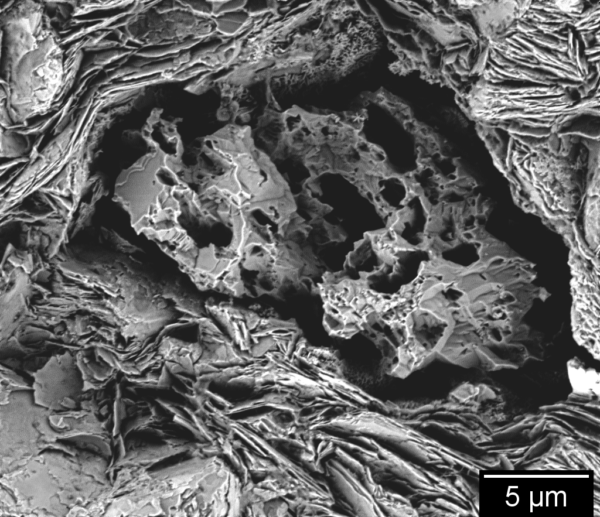
Etched particle of soil feldspar, the most common mineral in Earths crust. Photo credit: Xin Gu
Critical minerals are essential to many things we use every day, but most people probably don’t think much about where they come from.
When the way we procure minerals or elements is vulnerable to disruption and yet the minerals are essential to our economy or national security, we call them critical. Most people think such materials are rare and difficult to find, but the abundance of critical minerals (or critical elements) varies widely. For example, aluminum is considered a critical element because it is used for so many industrial and defense-related processes, but it is also the third most abundant element in Earth’s crust. Everyone has some aluminum in their local rocks or soils. The reason the availability of aluminum is considered vulnerable is that smelting aluminum out of mined rock such as bauxite uses a lot of energy. Aluminum is therefore only smelted in a few places worldwide, and if even one of those smelters is disrupted, it can cause economic hardship.
At the other extreme from aluminum, some elements are critical because they are only found in concentrated amounts in a few locations. A good example of that type of critical element is cobalt, a metal that is largely mined in the Democratic Republic of Congo. Since there are only a few mining locations for cobalt worldwide, the United States considers the supply of cobalt to be vulnerable. Beyond the two extreme critical elements of aluminum and cobalt, a few of the most famous critical elements—the so-called rare earth elements (REE)—are found just about everywhere but only at very low concentrations. This low abundance results in difficult and complex purification procedures that have only been perfected by a few countries. The underlying reason therefore that the REE are considered critical is that one country (China) controls much of the processing.
Most of us would not like to have a mine open up an industrial site or pit next to our house or neighborhood. Nor would we want all mines to be located in countries where environmental laws are lacking and health effects of mining are rampant. And yet, most of us rely on our phones and computers and cars for our lifestyles, and these would be unavailable without the materials mined from the Earth and the energy used for the mining and processing. Unless we start mining critical minerals on other planets or the moon, no one knows how to solve this dilemma on Earth, other than to double down on new forms of sustainable mining, to enhance our recycling capacity, and to develop renewable energies to drive these industrial processes.
Latest Posts

Special Feature
September 17, 2026
Beyond Calories: Jeffrey Gordon on How the Gut Microbiome Shapes Healthy Growth

Special Feature
August 20, 2026
World Mosquito Day Q&A with Nora Besansky: Understanding Malaria’s Most Vexing Vectors